Criteria for live donation of a liver:
- Must be in good physical and mental health.
- Must be between the ages of 18 and 60.
- Must have a body mass index (BMI) that is less than 35.
- Must have a compatible blood type with the recipient.
- Must be free from the following:
What are the criteria for donating a liver?
Dec 02, 2021 · Donate by Mail. If you prefer to make a donation by sending a check by mail you can do so here. Download this form and submit it with your check to…. Charitable Giving. American Liver Foundation. PO Box 299. West Orange, NJ 07052.
What are the risks of donating a liver?
When considering becoming a liver donor, it is important to contact your local transplant center to determine what type of surgeries they perform. Studies have shown that donating part of the liver does not affect a donor woman’s ability to have children. However, it is important for doctors to know if a living donor plans on having children.
How much money can I get for my liver donation?
In order to be considered as a potential live liver donor, you must: Be willing to donate without any pressure from a family member, friend or someone you know. Be healthy and free from any major physical or mental illness. Be between the ages of 18 and 55 and if …
Can you donate a liver and still live?
Who Can Donate a Liver? You Must Want to Do It. You're the only one who can decide to donate part of your liver. It's illegal for anyone to force you to do it. It's also ... You're a Family Member or Friend. You're in the Right Age Group. Your Blood Type Is a …
Does donating part of your liver shorten your life?
Whether you're giving away part of your liver or getting a new one, life often goes back to normal a few months after surgery. By the time you hit the 3-month mark, your liver will probably reach its normal size and you'll be back to your regular routine.Dec 3, 2019
What are the risks of donating part of your liver?
Risks Associated with Liver DonationPossible allergic reaction to anesthesia.Pain and discomfort.Nausea.Wound infection.Bleeding that may require transfusion.Blood clots.Pneumonia.Bile leakage, bile duct problems.More items...
Is it painful to be a liver donor?
You will have less pain as each day goes by, but most of our donors have a significant amount of discomfort for two to four weeks after surgery. Most pain medications make you drowsy, can affect your breathing and may cause nausea or constipation.
Can you donate your liver while your alive?
Living Donor Liver Transplant A small percentage of liver transplants are completed each year using a portion of a healthy liver from a living donor. Living donation is possible because the liver is the only organ that can regenerate itself.
What disqualifies you from a liver transplant?
acute rejection. the return of liver disease. cancer. medical complications, such as high blood pressure, infection, diabetes, and high cholesterol.
Can a woman donate a liver to a man?
Overall, data collected from transplants performed around the world showed that gender didn't seem to matter. But when the authors isolated the data from North America, they found female-donated livers that were transplanted into male patients were less likely to succeed than male-donated livers.Nov 6, 2002
How do I prepare to be a liver donor?
Criteria for live donation of a liver:Must be in good physical and mental health.Must be between the ages of 18 and 60.Must have a body mass index (BMI) that is less than 35.Must have a compatible blood type with the recipient.Must be free from the following:
Can you drink alcohol after donating a liver?
You cannot drink alcohol for a full year after surgery to allow your liver to recover. You will also be required to visit the hospital and lab repeatedly. You will gradually be able to return to your normal activities as you recover.
How long is liver donor surgery?
The entire liver donor operation will take five to seven hours.
Does insurance cover liver donation?
A: No – not to pay for costs of the donation, because the costs are billed to the health insurance of the recipient (person who receives the organ).
What is the age limit for liver transplant?
Liver transplantation from donors aged 80 years and over: pushing the limit. In the current context of organ shortage, the issue is not whether older donors should be used, rather how to use them and in which recipients.Dec 18, 2018
Can O positive donate liver to anyone?
If you have Type O blood, you are a "universal donor" and can donate to anyone (although Type O liver recipients can only get organs from people who are also Type O).Sep 29, 2021
How long does it take for a liver to grow back after a liver transplant?
It takes about six months for your liver to fully grow back after a living liver donation surgery. Our ultimate goal is to make sure you’re just as healthy after your living donation surgery as you were before your surgery.
How long do you stay in the hospital after a liver transplant?
Most living liver donors stay in the hospital for five to 10 days. The transplant team will also ask you to stay close to Salt Lake City (within two hours driving distance) until your surgeon decides you’re healthy enough to return home.
What tests are done for liver transplant?
Some of the testing you will have includes blood tests, urine tests, imaging exams of your liver, and cancer screening.
How long does it take for a liver transplant to regrow?
After donating part of your liver, your liver will regrow and work normally again within just a few months. Most people who need a liver transplant spend months or years waiting for an organ donation from a deceased donor.
Can you talk to another liver donor?
Our living donor program can arrange for you to speak to another donor who has donated a portion of their liver. If you’re nervous or don’t know what to expect, talking to another living liver donor can help you feel more confident about your decision.
Is it safe to donate a liver?
1. Living liver donation is safe. Your liver is an incredible organ. It actually regrows to its original size within six months of a living liver donation surgery. Like any surgery, the procedure does have some risks. But overall, living liver donation is safe. Our team will always act in your best interests and safety as a donor.
What is liver transplant surgery?
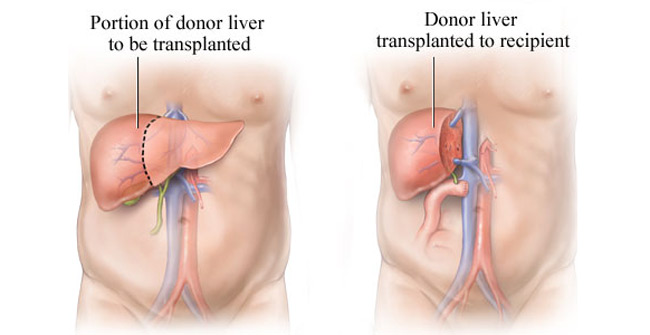
Surgery. In living liver donor surgery, the donor and the recipient are placed in side-by-side operating rooms. A surgeon removes a part of the donor’s liver, typically the right half. This donated segment of the liver is then immediately placed in the recipient in the next operating room. Many liver transplant surgeries are done laparoscopically, ...
What are the benefits of a liver transplant?
There are many benefits of receiving a liver from a living donor: 1 No waiting period 2 Surgeries can be scheduled at a convenient time for both the donor and the recipient 3 A liver from a living donor typically lasts longer than a liver from a deceased donor 4 A living liver transplant can be scheduled electively and before the onset of life-threatening complications while waiting for a liver from a deceased donor
Can you get a liver transplant from a living donor?
There are many benefits of receiving a liver from a living donor: No waiting period. Surgeries can be scheduled at a convenient time for both the donor and the recipient. A liver from a living donor typically lasts longer than a liver from a deceased donor. A living liver transplant can be scheduled electively and before the onset ...
How old do you have to be to donate liver?
Be healthy and free from any major physical or mental illness. Be between the ages of 18 and 55 and if a woman, not be pregnant.
What is the decision to donate a portion of a liver?
Deciding to donate a portion of one’s liver is a decision to undertake carefully, discussing the procedure and its risks with family, a personal physician and with the transplant medical and surgical team.
What are the requirements to be a donor?
If you want to be a donor, your liver, kidneys, and thyroid need to be working right. Transplant centers also want to know that you don't have medical problems like these: 1 Liver disease, including hepatitis 2 Diabetes (or a strong family history of the disease) 3 Heart, kidney, or lung disease 4 Gastrointestinal disease, autoimmune disorders, neurologic disease, and certain blood disorders 5 HIV/AIDS 6 Cancer (or once had some types of cancer) 7 High blood pressure that's not under control 8 Current or long-term infections, including hepatitis C 9 Use of alcohol or recreational drugs, including marijuana
How old do you have to be to get a transplant?
Most transplant centers want you to be between 18 and 60 years old, although the exact age range varies. The reason is that older donors tend to have more complications than younger ones. Transplant centers also consider children and teens to be too young to give the proper consent.
How long before surgery can you quit smoking?
Quitting tobacco 1-2 months before surgery can help lower the odds of complications. Quitting smoking even right before surgery can increase the amount of oxygen in your body. After 24 hours without smoking, nicotine and carbon monoxide are already gradually broken down in the blood.
Can you donate liver to someone on the waiting list?
If you're a blood relative, it's more likely that your blood type will be a good match for the person getting part of your liver. Some transplant centers, though, let you donate part of your liver to someone you don't know who's on the organ transplant waiting list.
Is it illegal to sell organs?
It's illegal for anyone to force you to do it. It's also against the law to sell organs. Transplant centers always make sure that their donors are doing this of their own free will, and you'll need to sign a consent form. You have the right to back out at any time.
How long does it take to recover from a liver transplant?
Typically, a liver donor spends approximately seven days in the hospital, and will have an additional six to eight weeks of recovery time.
How long does it take for a liver to regenerate after surgery?
Your liver will begin to regenerate immediately after surgery and will be back to normal size in six to eight weeks. Your recovery after discharge will be closely monitored with routine clinic visits and laboratory tests. If you are interested in becoming a living donor, call 410-614-2989 or download our living donor candidate packet.
How long after discharge can you drive?
You are instructed not to drive while on sedating medications, which are used at least two to three weeks after discharge. You are encouraged to walk several times a day.
Is it safe to donate a liver?
Risks Associated with Liver Donation. Even though live liver donation is considered a very safe operation, it involves major surgery and is associated with complications, which may include: Possible allergic reaction to anesthesia. Pain and discomfort. Nausea.
How much liver tissue is removed for a living donor?
A living liver donation surgery involves removing part of a person’s healthy liver — as much as 60 percent — and using this partial liver to replace the recipient’s diseased liver. In the weeks to come, both the donor and recipient sections will grow to the size of normal livers.
How many people are waiting for a new liver?
Still, demand far exceeds supply: More than 14,000 people in the United States are waiting for a new liver, according to the United Network for Organ Sharing. Livers are the second most-needed organ after kidneys.
What is a living donation?
Living donations save time: Living donation is intended to help a sick patient avoid the wait time for a deceased donor. That can mean an individual receives lifesaving intervention before his or her condition (typically end-stage liver failure, liver cancer or other rare and metabolic diseases) worsens.
How long does it take for a kidney donor to recover?
Recovery time is significant: A living donor who gives a kidney might be hospitalized for a few days and spend four to six weeks healing. Those who offer part of their liver, however, can expect to double that length of time.
Do liver donors know their recipient?
Most donors know their recipient: Because of the size and scope of the operation — plus the speed a decision to donate might require — a living liver donor typically has close ties to the recipient. Still, both sides must undergo a range of compatibility tests.
When did liver transplants start?
This shortage led to development of living-donor liver transplantation, first performed in the United States in the late 1980s. In the procedure, a healthy donor -- usually a blood relative -- undergoes an operation to remove a portion of his liver for the recipient.
How long does it take for a liver to regenerate?
Full regeneration generally takes six to eight weeks. For the new study, Ghobrial and colleagues collected information on 391 people who underwent living-donor liver transplantation at nine U.S. hospitals between 1998 and 2003. The donors were followed for an average of six months after their surgery.
Is it safe to donate liver?
July 24, 2006 (Boston) -- People considering sharing their liver with an ailing relative or friend can worry a bit less, say doctors who found that living donor liver -transplantation is relative ly safe. The largest North American study to date to look at how people who donate part of their livers fare after the procedure shows almost two in three ...
How old do you have to be to donate liver?
For example, at Mayo Clinic, donors must be 60 years old or younger to donate a portion of their liver. This age limit was established because the liver does not grow back as well or as efficiently in people over age 60.
What is a living donor?
Being a living donor is a life-changing choice, both for the donor and the recipient. As a donor, you give someone in need the amazing gift of a second chance at life. If you’re considering living donation, leave us a comment and tell us where you’re at in the process.
Can you become a living donor?
Becoming a living donor. If you’re approved to become a living donor, a piece of your liver will be removed and transplanted into a recipient. This procedure is possible because the liver has the unique and amazing ability to grow back and regenerate itself. Because the liver regenerates quickly, a donor’s liver will be back to its original size ...
What is the process of fertilization?
Our life starts with the fertilization of just two cells, a egg (ovum) and a sperm. These fertilize and divide to form an embryo. Embryo consists of stem cells. These stem cells can divide and form any cell or any tissue or any organ in the human body based on the molecular signals that they receive.
Do lizards regenerate after amputation?
In salamanders and lizards when an amputation occurs, their cells can go back (de-differentiate) to become stem cells and can then regenerate the amputated structure . In humans, the nearby cells multiply to form more cells of their kind when an injury occurs.
Do salamanders have regeneration?
Some animals like salamanders, lizards, starfishes, etc. have the capability of true regeneration. Their limb or tail might get amputated and they will grow a new limb or a tail, just like new. As awesome as that would have been but humans don’t have the same capabilities.
Popular Posts:
- 1. where to donate a car for charity
- 2. how to donate car in california
- 3. how to donate a car in pa
- 4. where donate blood
- 5. where can i donate my vehicle
- 6. where do i donate my car
- 7. what is the best charity to donate a car
- 8. where is the best place to donate a car
- 9. where to donate cars
- 10. where to donate my car for charity